
Thinking About a High-Capacity Tableware Forming Line? Here's What Actually Matters
Restaurants, retailers, private-label brands: they all need a compostable alternative that looks good, holds up, and can be supplied in real volume. If you're one of the manufacturers weighing an entry into pulp molding, the questions below are the ones that actually decide whether the investment pays off.
First, Know What You're Actually Buying
"Molded fiber" gets thrown around like it's one thing. It isn't, and the difference matters.
At the lower end you've got dry-pressed pulp molding — the stuff that makes egg trays and industrial inserts. It's cheap and cheerful, and the surface finish doesn't need to be pretty because nobody's eating off it.
Then there's the wet-pressed, thermoforming route. Here the wet pulp slurry gets formed on a mold and hot-pressed between heated dies, and what comes out is smooth, thin-walled, and rigid — plates, bowls, clamshells, cups that can actually go toe-to-toe with plastic on looks and performance. This is the tableware people want, the kind that resists oil and water without a plastic lining.
If you're chasing foodservice and retail customers, a thermoforming machine is almost always the right call. The margins are better, the products clear the aesthetic bar buyers expect, and you can build a premium lineup around it. It costs more upfront — but that's the point.
Dry-Pressed Molding
Egg trays and industrial inserts. Low cost, rough finish — fine when nobody's eating off it.
Wet-Pressed Thermoforming
Smooth, rigid, thin-walled tableware that competes with plastic on looks and performance.
Premium Margins
Retail-grade tableware earns more than commodity trays — and lets you build a premium lineup.
Why Capacity Is the Spec You Can't Ignore
Here's the thing about molded fiber: the raw material is cheap. Recycled pulp, bagasse, bamboo fiber — none of it will break you. What actually eats into your margins is energy, labor, and the cost of the machine sitting on your floor. And all three of those get better the more you produce.
That's the whole case for going high-capacity. A well-built line runs faster, uses multi-cavity molds, and pushes out serious volume from a single footprint. When you're making that many units, your fixed costs — the overhead, the drying energy per cycle, the people on the floor — spread thin across every plate and bowl. Suddenly the numbers work.
Automation is a big piece of it too. When forming, transfer, hot-pressing, trimming, and stacking all happen in one continuous flow, you're not paying people to shuffle product between stations, and you're not eating the defects that come from all that manual handling. A good line also gives you decent forming depth, so the same machine can turn out flat plates one day and deep bowls or cups the next — you're not buying a new platform every time a customer wants something different.
So no, capacity isn't just about "making more." It's what makes the math work at all.
Treat It Like an Investment, Not a Purchase
A fully automatic pulp molding line is a real commitment — this isn't a small piece of equipment you buy on a whim. So think it through the way an investor would, not a shopper.
How hard will you run it?
A line going three shifts pays itself back a lot faster than one sitting idle half the day. Build your case around the hours you'll realistically run, not the number on the brochure.
What's your yield?
Every defective plate is money you've already spent and can't sell. Lines with stable drainage, precise pressing, and good wall-thickness control give you cleaner output — protect that number, because it quietly decides whether you're profitable.
How much energy does drying eat?
Drying is the biggest running cost in this whole business, full stop. Ask about heat recovery and efficient dies, because that's where your cost per ton is really won or lost.
And what can you actually sell?
Premium tableware earns more than commodity trays. A versatile line lets you chase the profitable products instead of racing to the bottom on price.
Capacity isn't only a cost advantage, it's a sales one. The big foodservice and retail buyers sign with suppliers who can guarantee volume. Being able to say "yes, we can supply that" is often what wins the contract in the first place.
A Line Built for This: HGHY Pulp Molding Tableware Machine
If you want a concrete example of what a production-grade thermoforming line looks like, the HGHY Pulp Molding Tableware Machine is a good reference point. It turns sugarcane bagasse and recovered fiber into biodegradable plates, bowls, cups and lunch boxes — with forming and hot-pressing on one platform and robot auto-trimming built into the flow.
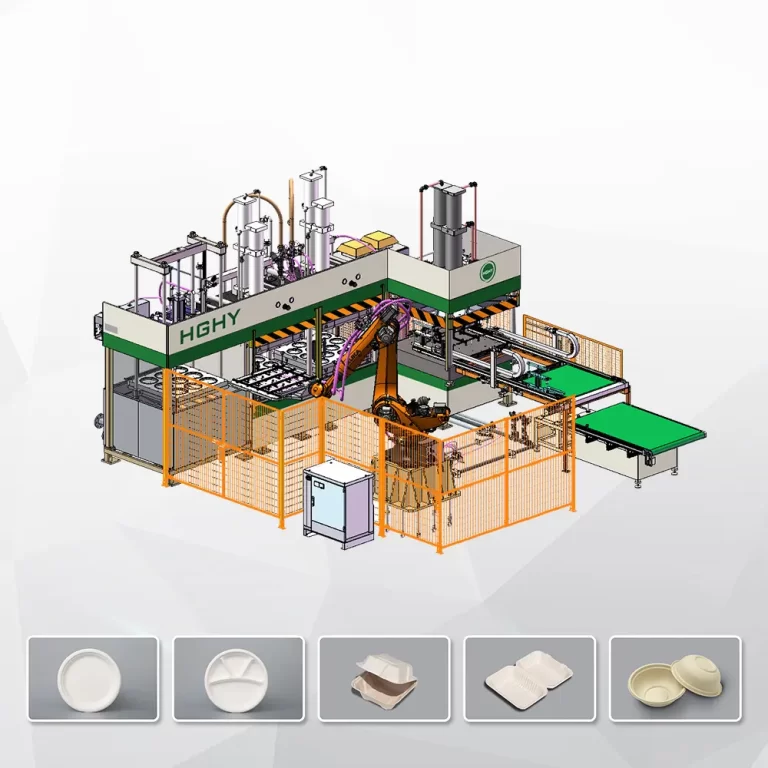
Pulp Molding Tableware Machine
A fully automatic, 1-forming / 2-hotpressing line with international-branded robot trimming, intelligent process control, and integrated trimming-and-stacking — engineered for stable, high-volume tableware production.
- ModelJZC2-9895Q
- Daily Capacity800 kg (±10%)
- Platen Size980 × 940 mm
- Forming / Hotpress1 Forming + 2 Hotpressing
- Max Product Height80 mm
- Heating EnergyElectricity / Thermal Oil
What makes it a useful benchmark is exactly the checklist above: automated forming-to-stacking flow (labor and defect control), robot trimming (yield), flexible heating options (energy cost), and enough forming height to cover plates, bowls and deeper containers on the same platform (product mix). It's the kind of configuration that turns the "invest, don't just buy" argument into something you can actually spec out.
Before You Sign Anything, Ask
- What's the real guaranteed output at your product spec — not the theoretical maximum?
- What yield rate will the supplier actually stand behind, and under what conditions?
- How much energy does it burn per ton of finished product?
- How many products and forming depths can it handle before you're stuck retooling?
- What automation, spare parts, and service actually come with it?
The Short Version
The demand for molded fiber tableware isn't a fad — the plastic bans aren't getting rolled back, and the buyers aren't going away. Cheap raw material, premium end-product pricing, and steady demand add up to a genuinely good business. But only if you can operate at scale. A high-capacity thermoforming line is what turns that opportunity into margins you can actually keep.
The question was never whether the demand is there. It's whether you'll have the capacity to grab it.